On November 12, 2026, Google explained how to recognize a visit that comes from Search, and why it sometimes arrives with no source. With the November core update rolling out, here is what to check in GA4 and in your logs before you read any drop.
If organic traffic to your site dropped this week, the obvious suspect is the November core update. Google started rolling it out on November 10, 2026, and says it can take up to two weeks. Check your measurement before you accept that story. Two days after the announcement, Google published a page on what the browser sends when someone leaves Search for your site, when that signal goes missing, and why your analytics will never match Search Console. A Google visit counted as "direct" looks exactly like an organic drop, and no algorithm caused it.
What does Google send when someone clicks a result?
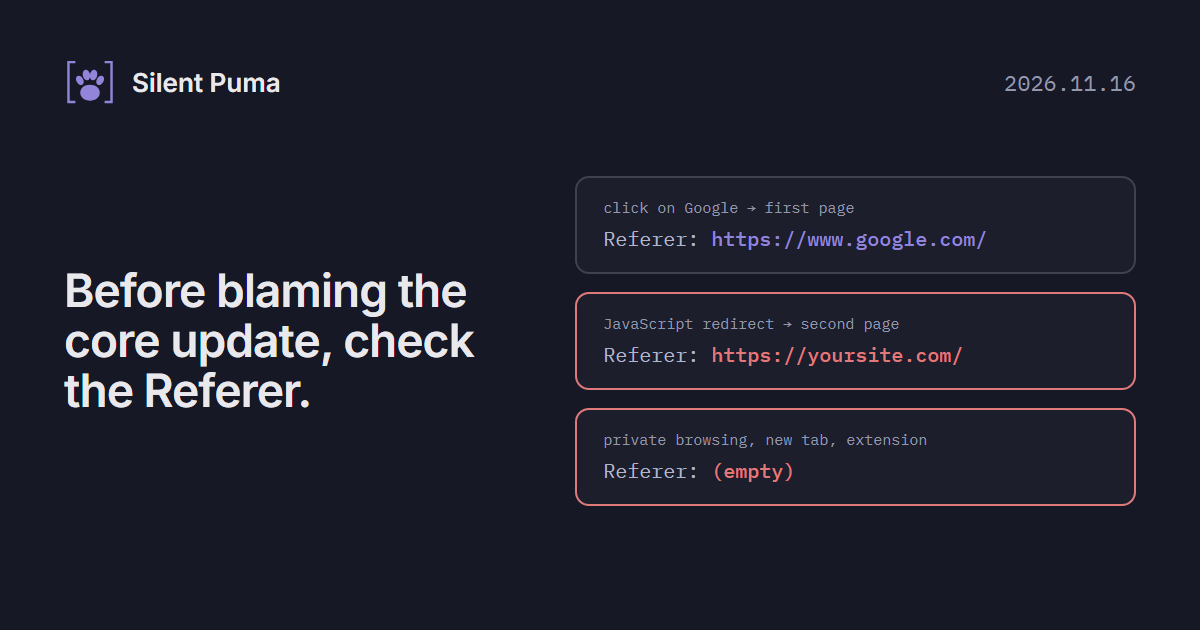
Just the Google address. Search applies the origin referrer policy, so the Referer header arrives as https://www.google.com/ or as a country domain such as https://www.google.co.uk/. The path and the query never travel with it. To learn which search brought the visitor, you need the Performance report in Search Console.
One value breaks the pattern. On Android, when the Google app opens the link in a browser tab, the Referer can read android-app://com.google.android.googlequicksearchbox/https/www.google.com. The iPhone app sends the ordinary address.
Images and Discover reuse the value of whatever surface showed the link. By Referer alone, then, a Discover visit is indistinguishable from a regular search visit. The page says nothing about AI Mode or AI Overviews. Anyone who claims to isolate that traffic by Referer is going further than Google had documented as of November 16, 2026.
When does a Google visit arrive with no source?
Often, and usually for reasons outside your control. Google lists private browsing, anti-fingerprinting protections, results opened in a new tab in some browsers, the hop from a phone search widget to a browser, and privacy extensions. The visit is real. It just shows up without saying where it came from, and analytics tends to file it under "direct".
Other causes live on your own site, and those you can fix. The most common one is a redirect done in JavaScript or with a meta refresh. The browser loads the first page, that page sends it to a second one, and the second page now sees your own URL as the Referer. The Google visit turns into internal traffic. A stricter referrer policy on the redirect can wipe the header entirely, and a redirect that drops the query string takes parameters like gclid with it.
Think about where this usually hides: a homepage that picks the language from the browser, an old page that forwards to a new one through a script, a consent banner that reloads the page. Did any of those change in November? Then the drop may have started with a deploy, not with Google.
Why does analytics never match Search Console?
Because they count different things at different moments. Search Console logs the click the instant someone picks the result. Analytics records the visit only after the page loads and the tag fires, so it misses people who leave early, decline consent or run a blocker.
Some traffic also lands on one side only. Search Console counts organic clicks and nothing else, while the Google total in your analytics may include Google Ads traffic, depending on how it is set up.
A gap between the two is normal. What deserves attention is the ratio over time. Steady clicks in Search Console next to a collapsing organic line in analytics point at measurement. When both fall together, that is when the core update earns a place in the conversation.
How do you read the core update without fooling yourself?
Wait for the rollout to finish. Google expects up to two weeks from November 10, 2026, and the status dashboard keeps the update marked as active until it ends. A Tuesday in the middle of it compared with the previous Tuesday measures the churn, not the outcome.
Treat Search Console as your ruler for what Google sent, since it does not depend on the Referer, on a tag or on consent. Compare periods of the same length with the same weekdays, and remember the data needs two to three days to settle.
If you follow the generative AI report in Search Console, add one more caveat. From November 9 to 11, 2026, it recorded fewer impressions than actually happened, because of a logging error Google itself annotated; real performance did not change. A dip on those three days, in that report, tells you nothing about the core update.
What to check on Monday
In GA4, open traffic acquisition by source and medium and look for google / organic. If google / referral, com.google.android.googlequicksearchbox or your own domain show up as referrers, some Google visits are being misclassified.
Review custom channel groups, the referral exclusion list and data filters. Google names all three as reasons a Search visit ends up counted as referral or direct.
List every redirect that is not a server-side 301 or 308: scripts, meta refresh, language pickers, consent. Move them to the server whenever you can.
In your server logs, count page requests only. Images, CSS and JavaScript also carry a Referer, but it holds your own page URL, and they inflate the count.
Put Search Console clicks and organic analytics sessions side by side, week by week, since October. If the ratio shifted before November 10, the cause predates the core update.